
Home » Areas of Work » Establishment and Monitoring of Experimental Fields
Establishment and Monitoring of Experimental Fields
Following the selection of the genotypes with the greatest adaptation potential, the ALCAROB project moves forward with the establishment and monitoring of experimental fields, making it possible to assess plant performance under real-world conditions in the Alentejo region.
Background
The establishment of experimental fields is a decisive stage in testing the performance of the genotypes selected during the previous phase of the project under real-world conditions.
Rather than simply validating the theoretical potential of the varieties, this area of work makes it possible to observe their adaptation to the region, monitor vegetative development, identify signs of tolerance to cold and frost, and collect valuable information to support future selection and propagation decisions.
Within the ALCAROB project, the experimental fields serve as a bridge between genetic selection and the potential future establishment of new orchards adapted to the Alentejo region.
Objective of This Area of Work
This area of work aims to establish and monitor experimental fields containing the selected genotypes, enabling the assessment of their adaptation, growth and performance under different conditions across the region.
How the Experimental Fields Are Established
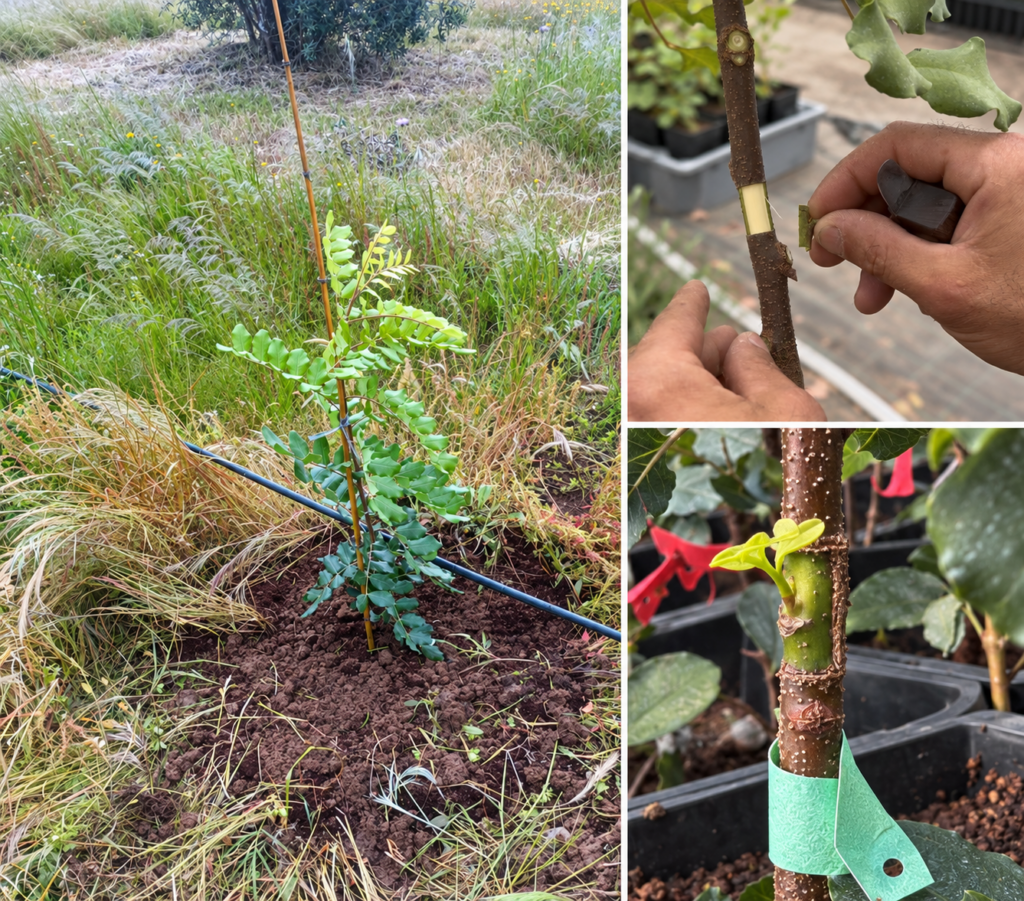
The experimental fields are established using plants obtained from the previously selected genotypes, making it possible to conduct controlled trials under real agricultural conditions.
At this stage, the project involves preparing the land, planting the different plant materials and arranging them in a way that enables comparison, monitoring and observation over time.
The experimental design is structured to ensure systematic monitoring, allowing genotype performance to be assessed based on agronomic and environmental adaptation criteria.
Experimental fields make it possible to turn the initial selection into practical observation, bringing the project closer to real production conditions.
What Is Monitored
Monitoring the experimental fields makes it possible to assess how the plants respond to their environment and to evaluate their performance over time.
The aspects monitored include vegetative growth, adaptation to the site, response to adverse climatic conditions and other indicators relevant to the future selection of the most promising genotypes.
This information is essential for reducing uncertainty, supporting technical decisions and strengthening the scientific robustness of the project.
We monitor vegetative growth and plant architecture throughout the growth cycle.
We assess the adaptation of each genotype to the soil, climate and water availability at each site.
We monitor tolerance to low temperatures and frost events.
The data collected informs decisions regarding the most promising genotypes.
Why This Stage Matters for the Alentejo Region
The experimental fields make it possible to determine whether the selected genotypes perform positively under the region’s real-world conditions.
This stage helps assess the potential of a new crop for areas where other species face greater limitations.
Monitoring generates valuable data to support future decisions on selection, propagation and orchard establishment.
The results obtained in the field can support the adoption of the crop in new areas of the Alentejo region.
A Stage That Guides the Next Steps
The experimental fields represent more than just a validation stage. The information collected during this phase helps identify the best-performing genotypes, guide the search for biomarkers associated with tolerance, and strengthen decisions regarding in vitro propagation and the future establishment of orchards.
In this way, this area of work helps connect selection, field trials, applied research and the future development of the crop.