
ALCAROB
ALCAROB is an applied research project that aims to strengthen and make available technical and scientific knowledge about the carob tree, assessing its potential as a sustainable crop for the Alentejo. By combining the selection of genotypes tolerant to cold/frost, the clonal propagation of selected genotypes, and biotechnological valorisation, the project seeks to identify solutions that will enable this crop to be expanded to more inland and colder areas, contributing to agricultural diversification and territorial sustainability. The project contributes to more sustainable, diversified and resilient agriculture, aligned with the Sustainable Development Goals.
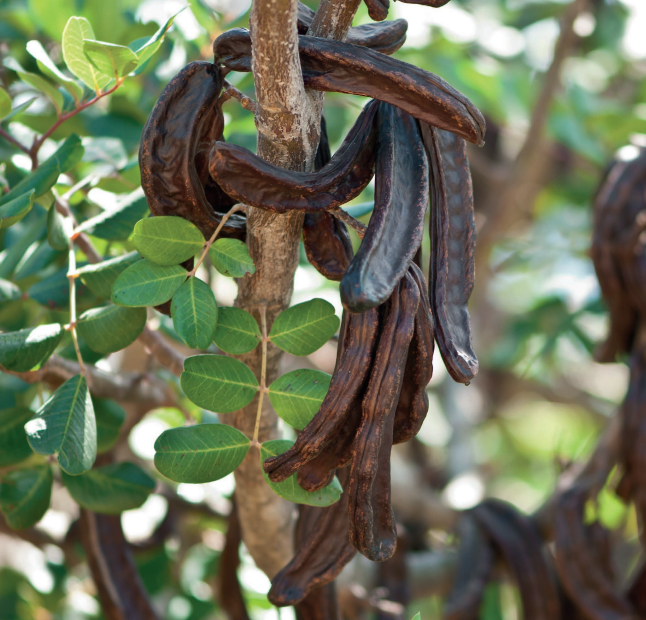
Project Pillars
Climate Adaptation
Selection of carob tree varieties with greater tolerance to cold/frost.
Sustainable Agriculture
A crop with low water requirements and potential for poor or degraded soils.
Biotechnological Innovation
Exploration of natural metabolites with potential use in biopesticides.
Territorial Impact
Agricultural diversification, regional valorisation and new economic opportunities.
Why this project is important for the Alentejo
The Alentejo faces growing challenges related to water scarcity, soil degradation, salinisation and climate pressure on agricultural systems.
In this context, the carob tree emerges as an alternative crop with strategic potential, due to its adaptation to Mediterranean conditions, resistance to abiotic stress factors and growing economic interest.
The ALCAROB project seeks to assess and accelerate this applicability in the territory, contributing to more resilient and sustainable agriculture.
Mission
To promote the scientific and technical knowledge needed to assess and expand carob tree cultivation in the Alentejo, following an approach based on sustainability, innovation and climate adaptation.
Objectives
To select genotypes tolerant to cold/frost, develop clonal propagation strategies and explore natural compounds with potential application in biopesticides.
Impact
To contribute to agricultural diversification, territorial valorisation, more efficient use of resources and the creation of new economic opportunities in the region.
Knowledge Valorisation and Application
Addressing Desertification and Climate Change
- The Alentejo faces water scarcity, soil degradation and loss of productive capacity.
- The project seeks to support the introduction of crops better adapted to this climatic context.
Introduction of More Water-Efficient Crops
- The project contributes to more efficient water management in agriculture.
- The carob tree is highly adapted to rainfed conditions and poor soils.
Selection of Genotypes Tolerant to Cold
- The species is sensitive to cold/frost, so the project selects varieties better adapted to these conditions.
- This approach may enable the crop to be expanded to new areas of the Alentejo.
A Viable Alternative for Poor and Degraded Soils
- The carob tree adapts to different soil types, including soils with low fertility.
- It represents a sustainable option for renewing the region’s productive fabric.
Reducing Pesticide Use and Ecological Transition
- The project explores natural compounds with potential application in biopesticides.
- This line of work promotes safer and more sustainable agricultural practices.
Creation of New Value Chains and Economic Opportunities
- The valorisation of fruits, leaves and metabolites may open up new industrial applications.
- The project contributes to diversifying and strengthening the regional economic fabric.
From Scientific Knowledge to Practical Application in the Territory
ALCAROB connects research, field experimentation and biotechnological innovation to support more sustainable and resilient agriculture in the Alentejo.
Entidade Financiadora
The ALCAROB project is funded by the Promove Programme of the “la Caixa” Foundation, in collaboration with BPI, and in partnership with the Foundation for Science and Technology (FCT) (Mobilizing R&D Projects 2024), within the scope of the ALCAROB project – Applicability of the Carob Tree to the Sustainability of the Alentejo Region (PD24-00024).
